If you have been pricing out hardwood, you have probably run into the term “cabin grade” next to a price that looks too good to be true.
It’s not a scam. It’s just a different appearance grade of the same product. Here’s what that actually means, what to expect in the box, and how to install it so it turns out well.
Cabin grade, shop grade, tavern grade
Manufacturers use a handful of names for this category: cabin grade, shop grade, tavern grade. Some throw in rustic or vintage, builder or character too. They all point to the same thing: hardwood that got pulled from a manufacturer’s first-quality line because it didn’t meet the manufacturer’s appearance standard.
None of these terms are standard across the industry. Names like cabin, rustic, or vintage are proprietary. Each manufacturer decides what falls inside that grade. One lumber mill’s cabin grade may be more consistent than another’s. There’s no single rulebook behind the label.
That’s why it matters to understand what you’re buying instead of going off the label alone.
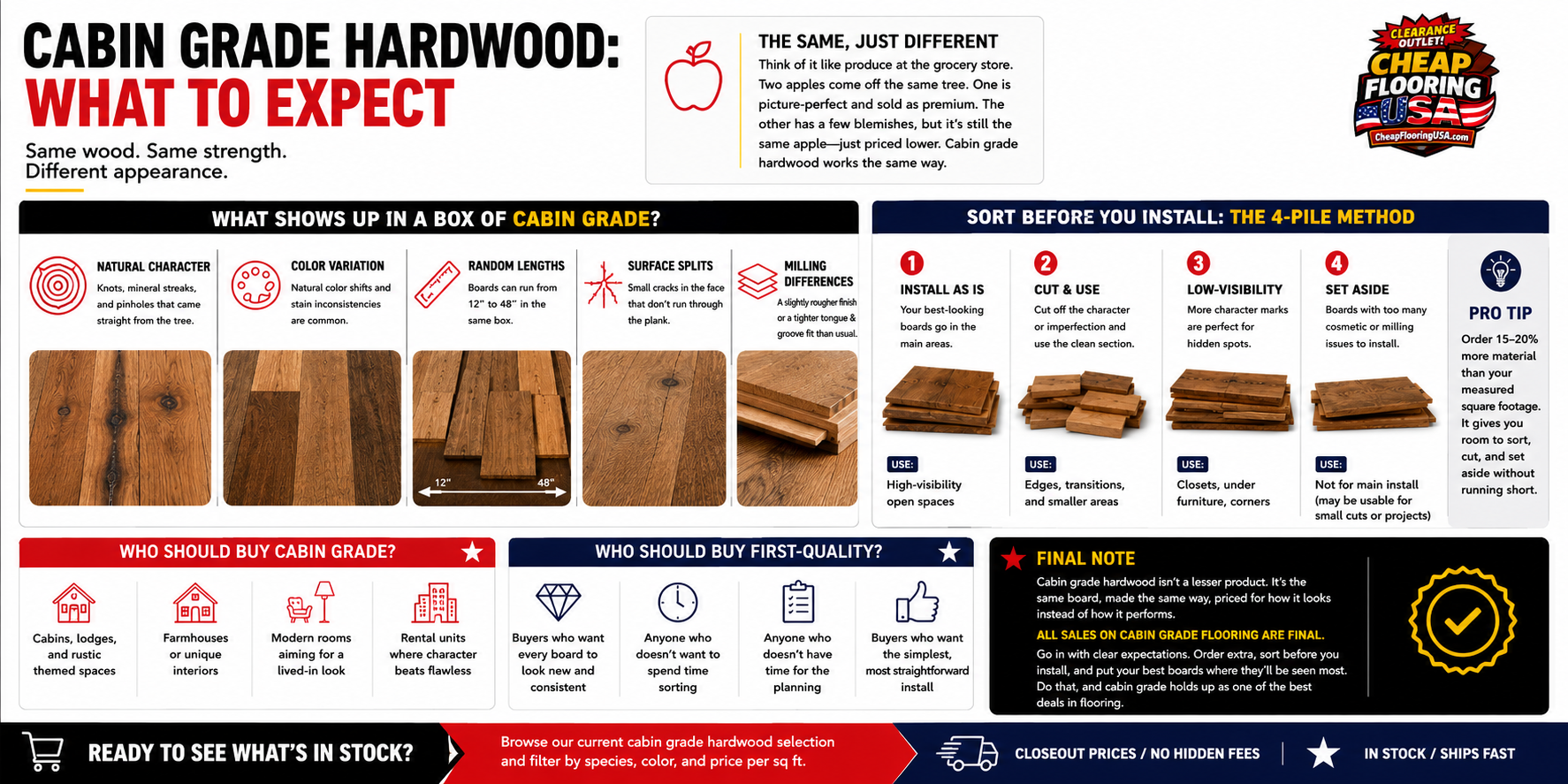
Think of produce at the grocery store. Two apples come off the same tree. One is perfectly round and brightly colored, so it goes into the premium display. The other has a blemish or unusual shape, so it's sold at a lower price. They still taste like the same apple. Cabin grade hardwood follows the same principle.
Why does cabin grade exist?
Hardwood comes from trees, and trees don’t grow to a spec sheet. Every manufacturer sets a bar for what counts as first-quality: consistent color, minimal visible marks, a clean surface finish. Boards that don’t meet those standards get pulled and sorted into a lower appearance grade.
The board itself isn’t defective. Many times, it comes off the same production line from the same manufacturer with the same finish applied. In most cases, cabin grade is downgraded for appearance rather than structural performance, but the exact grading criteria vary by manufacturer. For most manufacturers, the main difference is in how it looks.
Grades exist to group boards by appearance and milling tolerance, so buyers know roughly what to expect. The grades don’t qualify the structural performance; instead, they’re a statement on the appearance of the planks.
What shows up in a box of cabin grade?
Not every board has a visible flaw. Some look indistinguishable from first-quality. You may not even notice anything unusual.
Here’s some of the characteristics of cabin grade:
- Knots, mineral streaks, and pinholes that came straight from the tree
- Color variation, both natural shifts and stain inconsistencies
- Shorter, random board lengths: boards can run from 12 inches to 48 inches in the same box
- Surface-level splits: small cracks in the face that don’t run through the plank
- Milling differences: a slightly rougher finish or a tighter tongue and groove fit than usual
One box might be loaded with long boards. The next box from the same order might run mostly short. That’s normal for this grade, not a packing error.
Character or defect? Depends on who’s looking.
The part that confuses a lot of people:
The same board can read as a flaw to one buyer and a feature to another. Preference plays a big role. As they say, beauty is the eye of the beholder.
A rough patch reads as a flaw if what you want is smooth and uniform. That same patch is texture and works especially well for a distressed, rustic, or farmhouse look.
What does cabin grade work well with?
- Cabins, lodges, and rustic themed spaces
- Farmhouses or unique interiors
- Modern rooms aiming for a lived-in look
- Rental units where character beats a flawless look
If your goal is a floor that looks brand new and uniform from plank to plank, first-quality is the better call.
If you’re comfortable with natural variation or imperfection and want to save a significant amount per square foot, cabin grade is worth serious consideration.
Sorting and installing cabin grade the right way
People experience problems with cabin grade flooring when the installer doesn’t sort out the boards before installation.
Don’t assume every board is ready to go down as soon as it comes out of the box. You need to sort before you install.
A sorting process that works wonders
- Order 15-20% more material than your measured square footage. That overage gives you room to set aside boards you don’t want in the main install.
- Acclimate the flooring to the room before you start, same as you would with first-quality.
- Open three to five boxes before you begin, not just one. The box contents vary enough that judging the whole order off a single box will mislead you.
- Sort into four piles: boards to install as is, boards you can cut down and use the clean section, boards for low-visibility spots like closets or under furniture, and boards to set aside entirely. Some of those boards may still be usable for small cuts or hidden areas while others may have enough cosmetic or milling issues that they aren’t worth installing.
- Place your best boards in the open, high-visibility areas first. Save cut usable and more heavily marked boards for edges, corners, and spots that furniture will cover.
Treat it more like a puzzle than a straight, plank-after-plank install. That mindset shift is most of what separates a cabin grade floor that looks terrible from one that looks great.
Who should buy cabin grade?
- DIY homeowners comfortable spending extra time sorting through planks
- Rental property owners and landlords who need a durable, real wood floor without the first-quality cost
- House flippers with a tight budget
- Anyone leaning into a rustic, distressed, farmhouse, or lived-in look where natural variation is desirable
Who should buy first-quality flooring?
- Buyers who want every board to look new and consistent
- Anyone who doesn’t want to spend time sorting through boards
- Anyone who doesn’t have time for the planning that’s involved
- Buyers who want the simplest, most straightforward install
Cabin grade hardwood isn’t a lesser product. It’s made the same way, priced for how it looks instead of how it performs. You're trading visual consistency for a real hardwood floor at a fraction of the first-quality price and a little extra work.
All sales on cabin grade flooring are final, so go in with clear expectations. Order extra and sort before you install. And put your best boards where they’ll be seen the most.
Do that, and cabin grade holds up as one of the best deals in flooring.
Ready to see what’s in stock? Browse our current cabin grade hardwood selection and filter by species, color, and price per sq ft.
Note: Cabin grade coming soon